***The Librarian of Whispers***
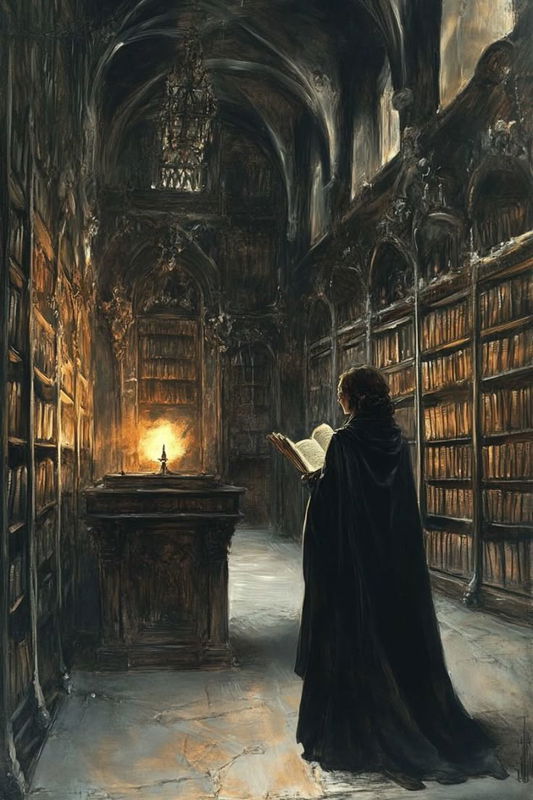

The last bell in the library of Atwood House was not a bell at all, but the sound of Elias Thorn sliding a particular book—a heavy, leather-bound volume of forgotten maritime law—back into its slot on the third-floor mezzanine. The resulting thud echoed in the cavernous silence, a permission for the old building to sleep. It was Elias’s ritual, the final duty of the Head Librarian. He descended the wrought-iron spiral staircase, his hand polishing a smooth sheen on the railing over decades of repetition.
The ground floor was a landscape of mahogany and dust motes dancing in the sunset slicing through high windows. At the main desk, his young assistant, Chloe, was packing her bag. “All set, Mr. Thorn? The new climate-control system is finally active. Says it will maintain a steady 65 degrees and 45% humidity. No more fighting the summer damp.”
Elias offered a thin smile. “A mechanical constancy. How modern.” He felt a pang for the old, temperamental radiators that hissed and groaned like living things. “Goodnight, Chloe. Don’t forget the Prentiss diaries need re-shelving tomorrow.”
“They’re already done,” she said cheerfully, heading for the oak doors. “See you Monday!”
The great doors thumped shut, leaving Elias in the profound quiet he loved most. He made his final round, a general inspecting his silent troops. The rows of books stood, orderly and eternal. He paused in the History section, his eyes scanning the familiar spines. And there, between The Reign of George III and The Corn Laws, he saw it.
A book he did not recognize.
It was slender, bound in a grey, cloth-like material with no title. Frowning, he pulled it free. The cover was blank. The pages, when he flipped them, were not paper, but something softer, more like vellum. And they were utterly empty. Not a single mark. Puzzled, he checked the catalog number on the shelf. It didn’t correspond to anything in the system. A misfit. Someone’s private notebook, perhaps, shelved in error.
He took it to his desk under the green-shaded lamp, intending to place it in the lost-and-found. As he set it down, the library’s new climate system clicked on with a soft hum. A precise, conditioned breeze wafted from a vent above. It ruffled the empty pages of the grey book.
And where the air touched, words began to form.
Elias stared, his breath catching. Elegant, copperplate script flowed across the page, line after line, as if an invisible pen were guided by the wind itself. He read, his heart thudding against his ribs.
“The first secret of Atwood House is not in the foundation stone, but in the keystone of the fireplace in the Reading Nook. It is loose. Inside, you will find a tin soldier, painted blue, belonging to Charles Wentworth, who hid it there in 1897 before being sent away to boarding school. He never returned to retrieve it.”
Elias looked up, across the dark library, towards the arched entrance of the cozy Reading Nook. It was impossible. He was a man of ledgers and catalogs, of provenances and fact. He stood, the book in his hand, and walked to the Nook. The massive stone fireplace was cold. He reached up, his fingers probing the central keystone. It wobbled, ever so slightly. With a librarian’s careful touch, he worked it free.
Behind it, cold and small, lay a little tin soldier, its blue paint faded. A king’s guard, missing his rifle.
A tremor, not of fear but of profound disorientation, went through him. He returned to his desk. The page in the grey book was blank again. The words had vanished as silently as they had come. He held the tin soldier in one hand, the empty book in the other.
He waited.
An hour passed. The great clock ticked. Then, the climate system hummed again, adjusting to the cooler night. Another gentle draft. The pages stirred.
New words bloomed.
“The second secret is buried in the soil of the potted fern by the east window. It is a love letter from Marian Hayes to Eleanor Stiles, dated 1912. It was never sent. Marian could not bear to destroy it, so she hid it where she knew Eleanor, who loved ferns, would sometimes tend.”
Elias moved like a man in a dream. The huge Boston fern had been in that alcove since before his time. He dug his fingers into the damp, peat-smelling soil near the root ball. His nails scraped against a small, sealed glass jar. Inside, folded tight, was a letter. The ink was blurred by moisture, but the salutation was clear: My dearest Eleanor…
He placed the jar next to the tin soldier on his desk. The book was again blank.
That night, Elias did not go home. He sat at his desk as the moon rose, watching the book. The climate system cycled on and off through the night, each whisper of air bringing a new confession from the library’s bones. He learned of a hidden will slipped behind a section of skirting board, of a diary detailing a staff member’s clandestine role in the suffrage movement, of a child’s chalk drawing of a dragon preserved on the underside of a desk. He found them all, each revelation a thread in the vast, hidden tapestry of the library’s life.
By dawn, Elias was surrounded by a strange museum of lost objects and unveiled truths. He was exhausted, exhilarated, transformed. The library was no longer a repository of stories; it was a living, breathing storyteller, and he was its sole confidant.
When Chloe arrived on Monday, she found Elias at the desk, looking older and yet somehow younger, his eyes gleaming with a new light. The lost-and-found box was overflowing with peculiar items.
“Busy weekend?” she asked, eyeing the odd collection.
“You could say that,” Elias said, his hand resting protectively on the grey book, now hidden in a drawer. “I did some… deep cataloging.”
“Well, the humidity’s perfect now,” she said, hanging up her coat. “Place feels different. Lighter, somehow.”
Elias looked out over the silent stacks. Sunlight fell in familiar bars across the floor, but he now saw the shadows they cast. He knew where every one of them fell, and what might be hidden within them. The library had trusted him with its silence, and now, with its whispers.
“Yes,” he agreed, a quiet smile on his face. “The air has changed everything.”

Comments
No comments yet. Be the first to comment!