the cartographer of lost countries


## The Cartographer of Lost Countries
Elara had always been able to see it in the cracks. Not Mundania—the greyscale, sensible world of bus timetables, tax returns, and instant coffee—but the shimmering edges of other places. As a child, she’d glimpsed the cobalt spires of a city called Veridian through the steam of her mother’s iron. She’d seen the amber glow of a forest where the trees sang in the rustle of her classroom’s radiators. The adults called it an overactive imagination. By thirty, Elara had learned to call it a liability, a thing to be medicated and managed. She was a librarian in a quiet town, her world bounded by Dewey decimals and the soft shush of her own making.
Until the day the map arrived.
It was tucked between the pages of a heavy, water-stained atlas being culled from the stacks. Not a printed map, but one drawn on thick, creamy parchment with what looked like ink made from crushed gemstones and twilight. At its centre, in elegant, looping script, was a title: The Oneiric Archipelago: A Partial and Perilous Survey. And beneath it, a smaller, urgent note: “For the Seer. It is fraying. Hold the borders.”
The map depicted no country on Earth. There was The Chromatic Queendom, a land of rivers that ran liquid gold under a permanently setting sun. The Republic of Echoes, where mountains repeated your thoughts back to you, wiser and more beautiful. The Wandering Atoll of Stolen Time, a floating island that collected forgotten hours and lazy afternoons. And in the far west, bleeding off the edge of the parchment as if it couldn’t be contained, The Wilds of Maybe.
Elara’s fingers trembled. She knew these places. Not from books, but from the periphery of dreams, from the half-second between wakefulness and sleep. These were her countries, the ones she’d been taught to ignore.
That night, she dreamt of the map. But in the dream, it was damaged. A ragged hole was tearing through the Lucent Lagoon, its bioluminescent waters leaking away into nothingness. The elegant bridge connecting the Isle of Whispers to the Mainland of Metaphor was crumbling, its stones falling into a silent void. A great, grey fog, labelled only “The Apathy”, was creeping in from the margins, dissolving coastlines and turning vibrant forests into faint pencil sketches.
She woke with a start, the taste of salt and loss in her mouth. It wasn’t just a dream. It was a distress call.
Her journey began not with a ship or a plane, but with a shift in attention. The instructions, she realised, weren’t written in words on the map, but in its substance. To reach the Oneiric Archipelago, you didn’t travel to somewhere; you travelled through a certain quality of attention.
She practised in her small apartment. Instead of making coffee, she stared into the swirling steam until it formed miniature weather systems over porcelain continents. She listened to the rain not as noise, but as a million tiny drums telegraphing messages from the Cloud-Kingdoms. She let her mind drift during her bus commute, not into daydreams, but into the specific, focused day-dreaming the map required—a conscious, willing suspension of Mundania’s rules.
One Tuesday evening, while mending a tear in her favourite cardigan, she focused not on the stitch, but on the gap it was repairing. She fell into the rhythm of the needle: in (the real world), through (the veil), out (the other side). Pull the thread tight. In, through, out.
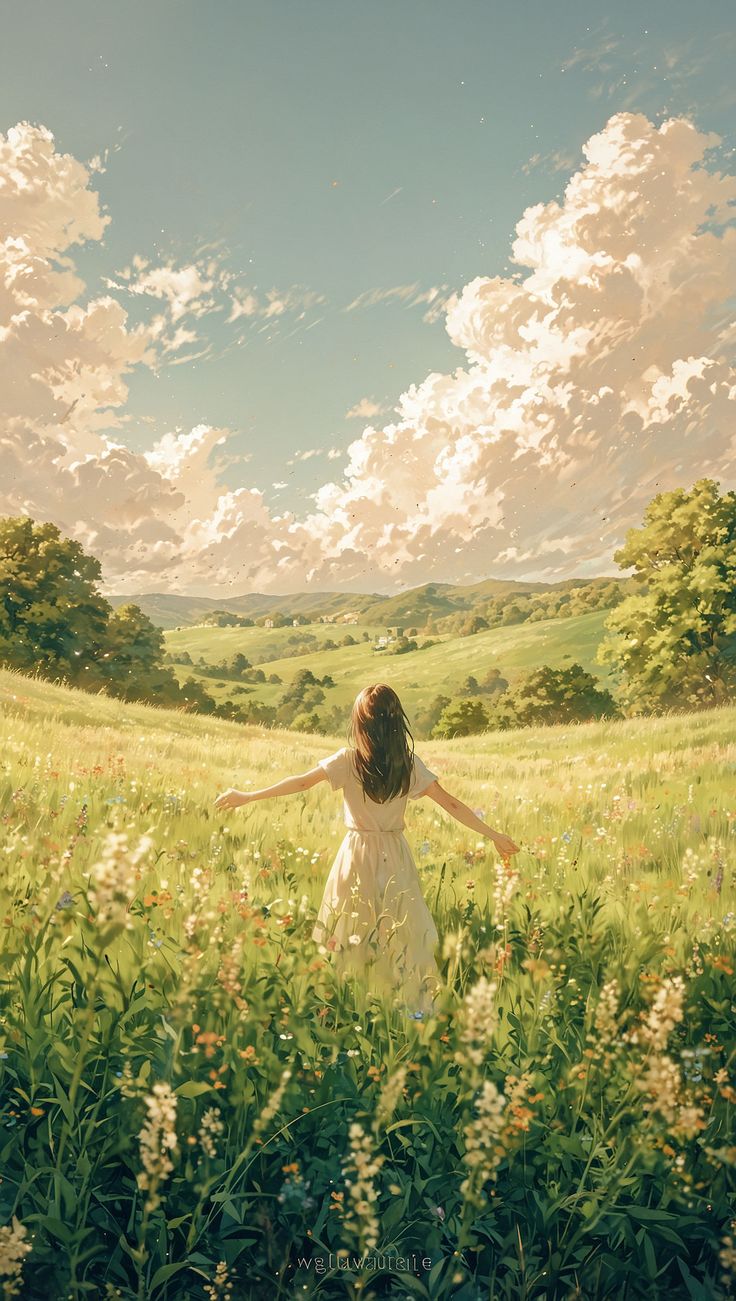
When she looked up, her sewing basket was gone. Her carpet was a field of soft, silver moss that glowed faintly. The air smelled of ozone and something sweet, like ripe peaches and lightning. She was on a hillside, under a sky where two small, friendly moons chased each other. In the valley below, lights sparkled in impossible colours. She was standing at the border of the Chromatic Queendom.
It was more real than real. The grass under her bare feet (she’d forgotten her shoes) wasn’t just green; it was a symphony of green, each blade a different shade, humming a low, verdant note. A butterfly the size of her hand, its wings a stained-glass window, landed on her wrist. Its touch was a polite question: Who are you?
“I’m the Seer,” Elara whispered, and the words felt true.
Her purpose became clear as she travelled. The Oneiric Archipelago was indeed fraying. The Apathy was a terrible, hollowing force. Where it touched, colours didn’t vanish; they became indistinct. Sounds merged into a bland hum. Unique, jagged mountain ranges smoothed into gentle, forgettable hills. It was the force of disinterest, of forgetting to wonder, of accepting the world as merely functional.
In the Republic of Echoes, she found the great Speaking Caves returning only the blandest, most literal interpretations of thoughts. “I am hungry,” a traveller sighed, and the cave echoed back, “*Metabolic deficiency detected*,” instead of its old, poetic reply, “*The oven of the world awaits your kneading.*” The magic was being stripped of its metaphor, reduced to data.
Elara learned she was a Cartographer-Keeper. Her job wasn’t to draw new lands, but to remember them vividly, to reinforce their reality through precise, loving attention. In the Wandering Atoll, she spent three days (or maybe three hours; time was fluid) helping a tribe of clockwork herons re-wind a great engine that captured the sighs of contentment from sleeping children—a prime energy source that was dwindling as children’s dreams became more anxious.
She met others like her, scattered across the islands. There was Corbin, a gruff, retired fisherman from Mundania who maintained the Tidal Flats of Memory by consciously remembering the smell of his first boat. There was Anya, a quiet botanist who tended the Garden of Unspoken Ideas, watering seedlings of potential with her focused curiosity.
“The Apathy feeds on inattention,” Anya explained, her hands deep in soil that sparkled. “Mundania is building bigger and better distractions. Every click, every scroll, every moment of ‘content’ that requires no depth… it starves us here. It makes the borders thin.”
Elara’s greatest test came in the Wilds of Maybe. This was the frontier of the archipelago, where new lands spontaneously coalesced from collective hope and old ones dissolved when their stories were completely forgotten. The Apathy was strong here, a grey wall advancing like a silent tide.
To hold it back, she had to do more than remember. She had to dream, actively and bravely. She sat on the shifting, pearlescent sands of the Maybe-shore and closed her eyes. She didn’t dream of escape or fantasy. She dreamt a specific, detailed dream: a Library of Lost Melodies, a place where forgotten tunes—the hum of a mother no longer living, the specific whistle of a forgotten spring wind—were catalogued and preserved. She dreamt it brick by brick, note by note.
When she opened her eyes, the grey fog had receded by inches. In its place, shimmering into existence, was the foundation of a building, and the faint, beautiful sound of a single, recovered violin note hanging in the air. It was exhausting, soul-aching work. She was dreaming not for herself, but for the very possibility of dream.
She learned the map was a living document, drawn by generations of Cartographer-Keepers. Her own perceptions began adding to it. Where she’d solidified a fading path with her memory, a firmer line appeared. Where she’d dreamed a new possibility against the Apathy, a tentative, glowing sketch emerged on the parchment, which she found updated itself in her backpack.
The crisis peaked at the Heartwood, the ancient tree at the centre of the archipelago whose roots were said to bind all the dream-countries together. The Apathy had reached it. Its leaves, usually each a tiny, swirling galaxy, were turning monochrome and falling, dissolving before they hit the ground.
The Keepers gathered—a handful of tired, ordinary-looking people from Mundania who were extraordinary here. The solution was not a battle. You couldn’t fight indifference with swords. The solution was a ceremony of re-enchantment.
They formed a circle around the Heartwood. Each would perform an act of pure, unnecessary beauty, an act that served no purpose other than to be wonderful. Corbin sang a sea shanty in a language that didn’t exist, his voice rough and true, weaving a net of sound. Anya grew a flower that changed colour based on the listener’s mood. Another Keeper, a former accountant, recited a epic poem about the love between two prime numbers.
Elara’s turn came. She thought of the children in her library, their eyes glazing over screens. She thought of the tired commuters on her bus. She reached into the pocket of her cardigan—the mended one, her anchor—and pulled out the only Mundane thing she had: a simple, smooth stone.
She didn’t speak. She held the stone and poured into it every mundane, overlooked beauty she could remember: the precise pattern of condensation on a cold glass, the satisfying thwip of a page turning, the geometry of a spiderweb jewelled with dawn, the silent, profound conversation of held hands. She remembered the real world with the fierce love of a cartographer, remembering its magic so the dream world could remember its own.
The stone began to glow, not with alien light, but with a warm, earthly luminescence, like a captured sunset. She placed it at the base of the Heartwood.
One by one, the other Keepers added their mundane anchors: a button, a key, a pressed leaf, a snippet of wool. A pile of ordinary things, radiating remembered love.
The grey tide of Apathy halted. Then, slowly, it began to recede. As it pulled back, colour returned to the leaves, not from without, but blooming from within, as if remembering what they were. The sound returned to the world—not just the fantastical sounds of singing trees, but the echo of the remembered, real wind, the memory of rain, the ghost of human laughter.
Elara returned to Mundania changed. The bus timetables were still dull. The tax returns still waited. But she could see the borders everywhere now: the dream-country shimmering in the steam of her kettle, in the shadow of a bird on the pavement, in the quiet space between two notes on the library’s ancient radio.
She became a different kind of librarian. She started a “Wonder Cabinet” in a corner of the children’s section—not for rare things, but for ordinary things presented with extraordinary attention: a magnifying glass over a single, perfect dandelion seed head, a recording of the different sounds of rain on various materials, a map of the constellations visible in the cracks of the library’s old ceiling.
She didn’t tell people about the Oneiric Archipelago. Instead, she taught them how to see the seams in their own world, how to listen for the echo of a dream in a passing breeze. She knew now that the two worlds were not separate. The dream-countries were the deep, subconscious resonance of the real one. To neglect the beauty of one was to impoverish the other.
Sometimes, late at night, she would open the map. New, faint lands were sketched at the edges: The Glimmering Sanctuaries, born from moments of peace in a frantic world; The Reclaimed Lands of Patience, growing where people put down their phones and watched a bird build its nest.
The work was never done. The Apathy always lurked at the margins, fed by cynicism and rush. But Elara, the Cartographer-Keeper, was no longer just a Seer. She was a builder. And she understood the most profound truth of all: a dream country isn’t a place you escape to. It’s a quality of attention you nurture, a space you make sacred within the real world. It’s the act of mending the fraying border between the mundane and the miraculous, stitch by conscious, loving stitch. For in the end, the survival of the dream depends entirely on the wakeful courage to believe the real world is worthy of wonder.
Comments
No comments yet. Be the first to comment!