memory weaver
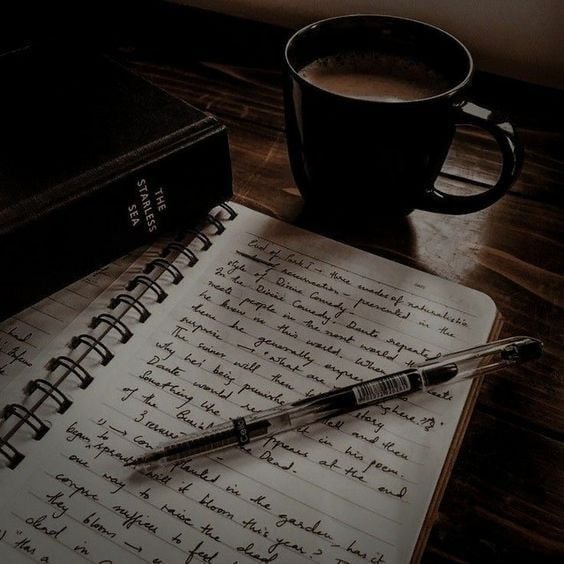

Eleanor found the letter on a Tuesday, tucked between the pages of a used book she’d bought for a quarter. The book was a tattered copy of The Collected Poems of Robert Frost, and the letter, handwritten on thin, blue airmail paper, was folded into the crease of “Stopping by Woods on a Snowy Evening.”
She’d only bought the book because the old bookstore on Main Street was closing forever. For forty years, it had smelled of dust and possibility, and now it was becoming a vape shop. Eleanor, a retired librarian with a widow’s quiet schedule, felt it was her duty to take a few orphans home.
She made tea first, a strong Earl Grey, and settled into her armchair by the window. The autumn rain was a soft percussion on the glass. Then she opened the letter.
June 12, 1962
My dearest Juliet,
I am writing this not because I have the courage to send it, but because if I don’t write it, the shape of these words will press against my ribs until I can’t breathe.
I saw you yesterday, walking past the university library. You were wearing that green dress, the one that matches the moss on the old stone walls back in Donegal. You stopped to tie your shoe, and for ten seconds, you were the only still thing in a moving world. I was thirty feet away, holding a stack of books I don’t remember checking out, and I felt my entire future rearrange itself.
I know your name is Sarah. I know you’re studying botany. I know you laugh with your whole body, like surprise is the best part of the joke. I have never spoken to you. And that is my great shame.
My father wants me to take over the hardware store. He says dreaming is a luxury for people who can afford to be poor. But you make me want to be a poet, a painter, a man who builds ships in bottles just to prove that small things can hold oceans.
I will never send this. But I will leave it somewhere. In a book, perhaps. On a park bench. The world is full of quiet places where unsent love can rest.
If you ever read this, know that on a Tuesday in June, a man you never noticed loved you completely.
Yours, in secret,
Patrick
Eleanor read it twice. Then she set it down and looked out at the rain. Her own husband, Thomas, had never written her a letter. He’d proposed over a plate of meatloaf. “So, we’re good together, right? Might as well make it official.” She’d loved him for his straightforwardness. But now, with the blue paper trembling in her hand, she wondered what it might have been like to be loved in secret first, to be a Juliet to some quiet, unseen Patrick.
She checked the book’s front matter. No inscription. No name. The letter could have been hidden there for decades. Patrick might be an old man now, or he might be dust. Sarah might have lived her whole life without ever knowing she’d been a muse.
Eleanor did something she rarely did. She called her daughter, Chloe, who lived three states away and worked in digital marketing.
“Mom? Everything okay?”
“Fine, sweetheart. I have a… project for you.”
She described the letter, the names, the date. Chloe, who thought her mother’s retirement was dangerously close to premature rigor mortis, agreed with suspicious enthusiasm. Within a week, she had done what a private detective might have charged thousands for. She found Sarah.
Not the young woman in the green dress. But Sarah, age 84, living in a small assisted living facility outside Burlington, Vermont. Her husband had passed five years ago. She had two children, four grandchildren. And yes, she had studied botany at the university in 1962.
Eleanor drove six hours through the tail end of a nor’easter. She arrived at the facility, a cheerful place called Maplewood Gardens, with the letter in a plastic sleeve and the Frost book in her lap.
Sarah was in the sunroom, knitting a blanket the color of mustard. Her hair was a white cloud, but her eyes were still sharp, still the kind of eyes that notice moss on old stone walls.
“Mrs. Sarah Cross?” Eleanor asked.
“Just Sarah. Who’s asking?”
Eleanor sat down. “My name is Eleanor. I think I have something that belongs to you.”
She handed over the letter. Sarah read it in silence. Her knitting needles stopped their soft clicking. When she finished, she looked out the window at the bare November trees. A long time passed.
“Patrick,” she whispered. “Patrick… O’Brien. There was a boy. He worked at the hardware store on State Street. I used to see him through the window. He always looked so… lonely. But I was engaged to Harold by then. Harold was safe.”
She pressed the letter to her chest. “He never spoke to me? Not once?”
“The letter says he didn’t have the courage.”
Sarah laughed, and just as the letter had promised, it was a laugh that used her whole body. “All that time. He was thirty feet away, and I was thirty feet away, and neither of us knew we were looking at the same thing.”
Eleanor reached into her bag. “There’s one more thing.” She pulled out the Frost book and opened it to the poem. “Stopping by Woods on a Snowy Evening.”
Sarah’s trembling fingers touched the page. “He wrote in the margins.”
Eleanor looked. She hadn’t noticed before. Next to the final stanza (*And miles to go before I sleep, / And miles to go before I sleep*), Patrick had scrawled in faint pencil: Unless I stop here. Unless I stay.
“Did you ever find him?” Eleanor asked.
Sarah shook her head, but she was smiling. “No. But I think maybe… he found me.”
They had tea in the sunroom while the rain turned to sleet. Sarah talked about botany, about the language of flowers, about how the wild violets she studied in 1962 were now endangered. Eleanor talked about Thomas, about the meatloaf proposal, about the quiet, daily love that never needed a letter to prove it was real.
Before she left, Eleanor took the blue airmail paper and copied the letter onto a fresh sheet. She gave the original to Sarah.
“What will you do with yours?” Sarah asked.
Eleanor folded the copy and tucked it into her own coat pocket, next to her heart. “I think I’ll leave it in a book somewhere. Let someone else find it. The world could use a few more unsent loves.”
Driving home through the fading storm, Eleanor felt something shift in her chest—not the shape of a man’s name, but the shape of her own. She had been a librarian, a wife, a mother. She had spent her life shelving other people’s stories.
But for the first time, she wondered what it might feel like to be the one who writes. Not a letter to a stranger. A letter to herself. A letter that begins: Dear Eleanor. You still have miles to go. And that is not a tragedy. That is a gift.
She smiled, turned up the heat, and kept driving.
Comments
No comments yet. Be the first to comment!